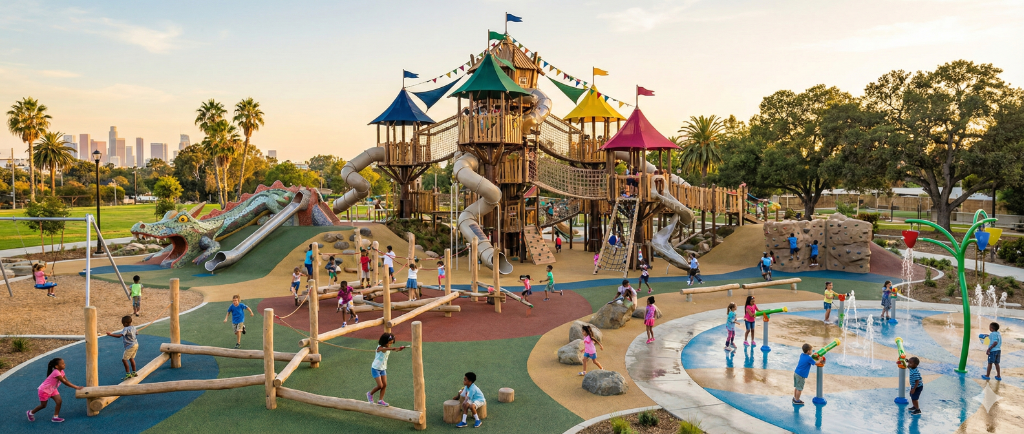
When an HDB town council identifies an ageing playground that needs upgrading to meet current safety standards, the process involves navigating town council approval workflows, designing within spatial constraints, and ensuring compliance with established safety standards. This guide outlines the typical phases of a playground refurbishment project in Singapore.
Phase 1: Site Assessment
A professional site assessment is conducted to evaluate the playground condition:
- Equipment condition — Documenting structures for signs of corrosion or structural concerns.
- Surfacing condition — Checking the depth and integrity of existing materials (e.g., sand or rubber) regarding impact attenuation.
- Site dimensions — Measuring the play area, fall zones, and clearance to pathways.
- Underground services — Identifying drainage and electrical infrastructure.
Phase 2: Design and Proposal
Design proposals typically include age-separated zones and equipment that meet safety requirements. Standard playground equipment costs start from SGD 350/sqm. Proposals include:
- Equipment Selection — Multi-play climbing structures, toddler units, or swings.
- Surfacing Specifications — Two-layer wet-pour EPDM, which includes a shockpad and a wear course. EPDM surfacing costs start from SGD 90/sqm.
- Ancillary Works — Concrete works (from SGD 100/sqm) and drainage improvements to prevent water ponding.
Phase 3: Approval and Compliance
Upgrades require several layers of documentation and approval:
- Town Council Endorsement — Presentation of the proposal for budget and design approval.
- Compliance Documentation — Providing SS 457 and EN 1176 certificates for all equipment.
- Safety Standards — Ensuring the design adheres to EN 1177 for impact-attenuating surfacing.
Phase 4: Installation
Site Preparation and Equipment
- Removal and Disposal — Dismantling old equipment and disposing of old surfacing. Disposal costs start from SGD 3.50/sqft.
- Foundations — Setting equipment foundations using cast-in-place concrete.
- Assembly — Installing climbing structures and swings, ensuring all clearances and entrapment gaps are checked against SS 457 and EN 1176.
Surfacing Installation
- Base Layer — Poured SBR shockpad base layer to the required thickness for the equipment's free fall height.
- Wear Course — Poured EPDM wear course in specified colors.
- Curing — Allowing the surface to fully cure before allowing foot traffic.
Phase 5: Post-Installation Certification
Before the playground is opened to the public, a competent playground inspector must conduct a post-installation inspection. Post-installation certification starts from SGD 600. The inspection covers:
- Equipment Compliance — Checking all structures against SS 457 and EN 1176 for entrapment, protrusions, and structural integrity.
- Surfacing Compliance — Verifying impact attenuation (CFH) against equipment fall heights per EN 1177.
- Safety File — Issuing a compliance certificate and compiling manufacturer documentation for the town council's safety records.
Key Best Practices
- Comprehensive Documentation — Submitting all certificates and test reports promptly can facilitate the approval process.
- Zoning — Separating toddler and older-child play areas helps reduce collision risks.
- Drainage Management — Proper drainage is essential to protect equipment from premature corrosion.
- Professional Inspection — Post-installation certification by a qualified inspector is a critical safety step for public-use playgrounds.
Kinderbuild Team
Singapore's trusted playground contractor with over a decade of experience delivering SS EN1176-compliant installations across schools, condominiums, and public parks.